Automation for channel cuts
Ditch Assist follows the terrace channel target and helps maintain the designed fall to the outlet as the machine works along the surveyed path.
Ditch Assist™ is centimeter-accurate RTK GPS grade control and guidance for field machines — one kit, one Android tablet, any compatible RTK source. Terracing is an included workflow. Buy the kit for this job and every other surface workflow comes with it — surface drainage, tile drainage, land forming, single-grade work, levees, leveling — at no extra cost, no per-mode activation.
Terracing mode turns channel grading into a dedicated workflow for the whole structure: channel survey, berm survey, channel design, berm-height verification, cut/fill balance, and pass-by-pass channel cuts.
Two things usually make terrace work hard by eye: keeping the channel draining cleanly to the outlet, and keeping the berm high enough above the channel to meet the job spec. Terracing mode handles both as one system while the operator stays in control of how material is placed.
This is the in-app workflow an operator follows in the field: check module and RTK GPS status, set survey blade height, record the terrace channel, survey the berm, build the Slope-IQ design, use Auto-Balance to compare channel cut against berm fill, stage deeper cuts with Auto-Nudge, then grade the channel and verify berm height.
Set survey blade height, record the terrace channel, confirm outlet direction, then survey the top of the berm for height feedback.
Compare Best-Fit, Guided, and Freeform channel designs, set minimum grade and berm height, then balance cut volume against fill needs.
Stage the channel cut pass by pass, use Hold for manual guidance when needed, then switch to Berm to place material to target height.
This walkthrough simulates the full Terracing mode flow in the Ditch Assist app, matching what an operator does when maintaining or building a farmable terrace.
Use the setup walkthrough to get field data and machine checks handled before opening Terracing mode for the channel and berm survey.
Wide-base, broad-base, and farm-over terraces are not just one grade line. The channel, berm, outlet, and cut/fill volume have to agree before you start moving dirt.
Design a clean channel profile from inlet to outlet so water does not sit in pockets along the run.
Survey the berm line and verify height as you place soil, instead of guessing from the seat.
Auto-Balance compares channel cut to compaction-adjusted berm fill so shortages show up before the job is half-built.
Guided and Freeform design let you lift the channel through a low area so the plan fills it instead of cutting deeper.
Auto-Nudge steps the channel target down pass by pass, based on the cut depth your scraper or blade can handle.
Run Automation or Guidance on pull-type scrapers, land-forming blades, land levelers, and Pulldozer™.
Two surveys, one design, one grade session. Drive the channel, drive the berm, let Slope-IQ™ lay the channel cut, hit Auto-Balance, then grade the channel while Auto-Nudge™ manages multi-pass cuts. Build the berm with live target feedback as the cut volume accumulates.
Tap the Terracing card and choose New Surveys. Drive the planned channel centerline at a steady pace, tap Stop, save it (“Terrace 12 channel”). Confirm direction (Ditch Assist reads inlet/outlet from elevation), then drive the berm centerline on the downhill side and save (“Terrace 12 berm”).
The Terrace Design dialog opens with Slope-IQ™ on the channel survey. Set Depth Offset, Min Grade, Bottom Width, Min Berm Height, and Side Slope. Step through to Berm Analysis — if cut volume falls short of compaction-adjusted fill, tap Auto-Balance and the dialog deepens the channel until the volumes match.
On the Grade screen, the sidebar Channel/Berm toggle picks the active phase. Cut the channel first with Auto-Nudge™ staging each pass. When the channel is on grade, switch to Berm and place the accumulated soil while the tablet shows the berm target.
Survey the channel and Ditch Assist grades it cleanly to the outlet — on minimum grade, delivering the cut volume your berm needs. The design engine is called Slope-IQ.
Three engines design the channel cut. Automation when you want it, control when you need it.
Slope-IQ™ works out the channel profile from your survey — respecting your minimum drainage grade, your depth budget, and the geometry that lets the berm above it hold to height. Best-Fit hugs the terrain, Guided enforces your grade-break points, Freeform lets you place every vertex yourself.
Set Min Grade and Depth Offset, and Slope-IQ™ solves the channel — following the natural slope where it works, cutting through humps that hold back flow, moving the least dirt possible while still delivering enough cut volume to build the berm.
Anchor grade-break points where elevations must hold — a tile inlet at the head, a grassed waterway at the outlet, a road crossing in the middle — and Slope-IQ™ connects them with same-grade segments that respect your minimum drainage.
Best-Fit always grades down from the bottom of any depression along the route. On long terraces with a tight outlet elevation, that can cost more depth than your slope budget allows.
Use Guided or Freeform to place the channel above a low spot — the system then plans to fill that section of the channel instead of cutting deeper. The volume strip updates accordingly: Channel Cut minus Channel Fill minus Berm Fill (compaction adjusted) equals Net Balance. Check the number before you start — a positive balance means the channel cut covers both filling depressions and building up the berm; a negative balance tells you up front you'll need to haul fill in from elsewhere (uphill, a borrow area, or a neighboring field).
Channel Cut − Channel Fill − Berm Fill (compaction adjusted) = Net Balance
Positive: the channel cut covers filling depressions and building the berm. Negative: haul in fill before you start.
A terrace channel is rarely a one-pass cut. Ditch Assist stages it pass by pass so the scraper never bites off more than it can pull. That engine is Auto-Nudge.
Deep channel cuts are rarely a one-pass job. Auto-Nudge™ stages the channel cut across multiple passes — never letting the implement bite off more than your scraper can handle. Set the max cut per pass, drive the route, tap Pass + at the end of each pass, and the system steps the target depth down until you're on final grade.
Set the deepest single-pass cut your scraper and conditions can handle. Default 2″. The design dialog shows the estimated channel-pass count before you implement.
Each pass cuts the channel deeper toward final grade — never more than your max cut. The profile chart shows the active pass bold, future passes faded — you always see what's left to cut.
End of a pass, tap Pass + in the sidebar. The system sets the next target depth and you keep cutting. When the channel is on final grade, flip the Channel/Berm toggle and build up the berm — berm building is operator-paced as the fill accumulates.
Terracing needs cut-and-place capability — soil from the channel goes onto the berm, not off-site. Pull-type scrapers are the workhorse; land-forming blades and the Pulldozer™ fit too. Pick yours for setup and compatibility details.
Both the Automation Kit and the Guidance Kit add RTK GPS grade control to any hydraulically operated pull-type scraper for terracing work. The Automation Kit drives the raise/lower hydraulics automatically — PWM valve, hoses, fittings, and a manual-bypass circuit all included. The Guidance Kit gives live on-screen on-grade feedback so the operator works the hydraulics manually — control module and harness only.
Scrapers are the natural fit for terracing: they cut the channel and dump the fill onto the berm in the same pass. Min/max Duty Cycle (DC) settings in the app tune hydraulic responsiveness for typical scrapers used across Western Canada and the Northern U.S. Turn up DC for larger units, down for smaller. Optional high-flow valve spool upgrades are available for extra-large scrapers.
Because the kit is portable and mounted on the implement (or tractor), you can swap between tractors throughout the day. Wireless communication from valve to cab means minimal wiring — change tractors and be back terracing in under an hour.
Slope-IQ™ designs the channel cut. Auto-Balance matches cut volume to compaction-adjusted berm fill. Auto-Nudge™ stages the channel cut pass by pass so the scraper never bites off more than it can handle.
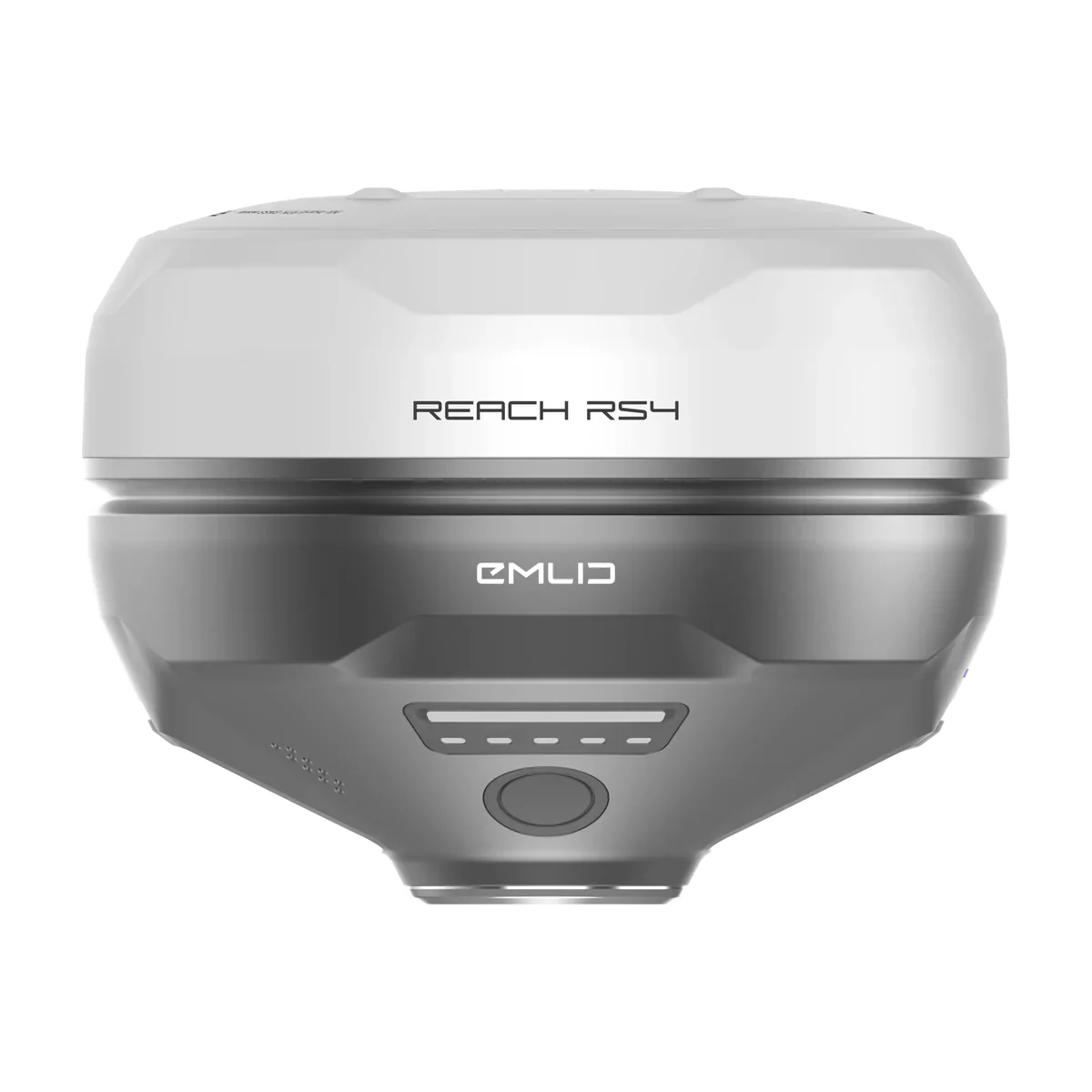
Compatible with any RTK GPS. Ask about our affordable Emlid Reach RS3 or RS4 bundle if you're starting fresh.
Both the Automation Kit and the Guidance Kit add RTK GPS grade control to land-forming blades, land levelers, and the Pulldozer™. The Automation Kit drives the raise/lower hydraulics so the blade tracks each phase target automatically; the Guidance Kit gives live on-grade feedback while the operator works the hydraulics manually.
For terracing, Ditch Assist controls the raise/lower function only. Other blade functions — tilt, side-wing — stay manually operated. For tilt-capable blades, keep tilt constant from initial survey through to grading; changing it mid-operation alters the GPS height offset and causes deviation from your intended grade.
Slope-IQ™ Best-Fit, Guided, and Freeform engines design the channel profile. Auto-Balance matches volumes. Auto-Nudge™ stages cut depth on the channel pass so the blade never bites off more than the tractor can handle.
Wireless valve setup (Automation Kit) means fast swaps between tractors. Works with any RTK GPS; ask about our affordable Emlid Reach RS3 or RS4 bundle.
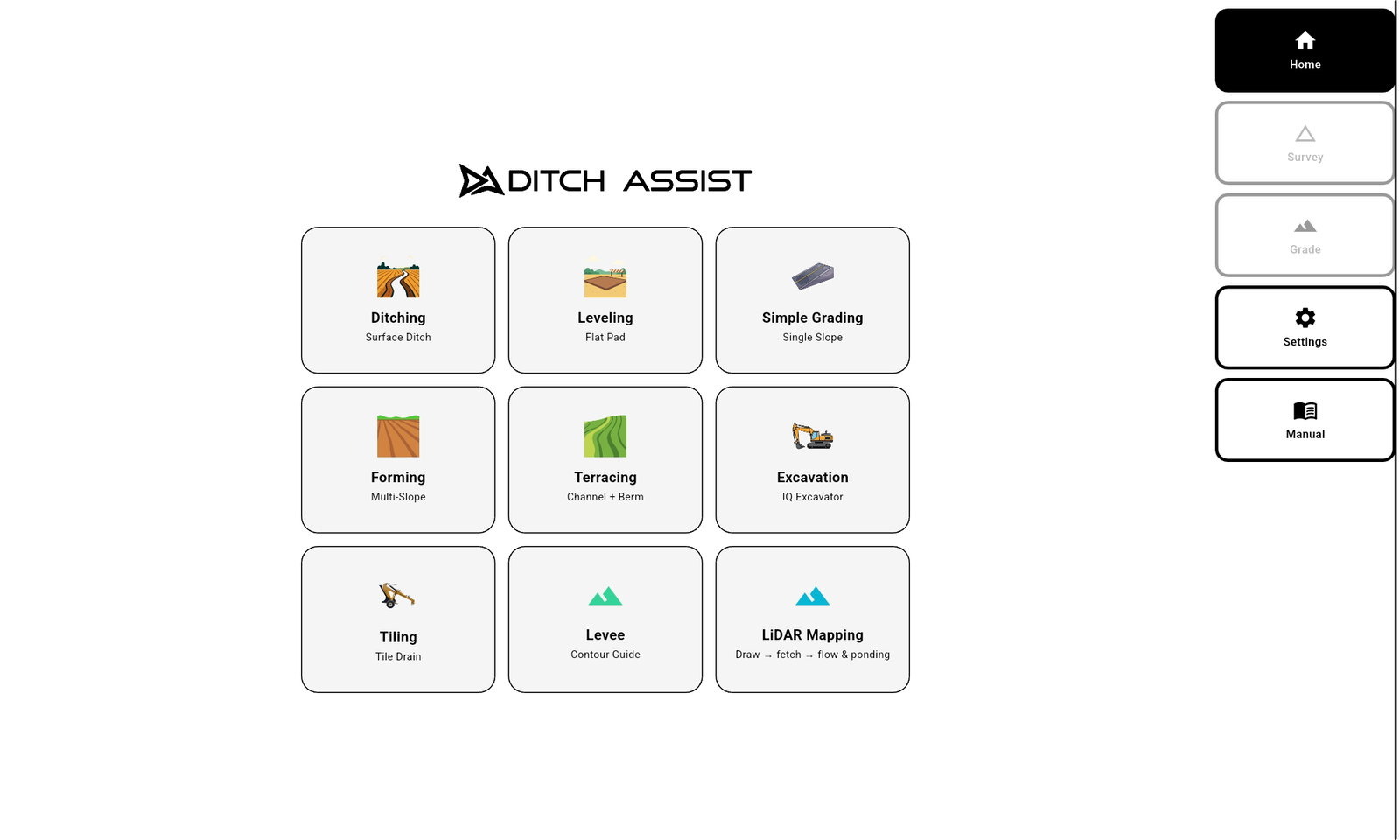
Whichever kit you buy for terracing — Automation or Guidance — unlocks every other surface workflow in the Ditch Assist app. No extra cost, no per-mode activation. Surface drains in the spring, terraces this summer, a bin pad in the fall — same kit, same tablet, same operator.
Surface drainage — survey the route, Slope-IQ designs it, auto-grade pass by pass.
See Ditching → Mode 03Variable-slope and all-way designs from OptiSurface™, Ezigrade™, Topcon™ AGForm-3D™, AGD, and LandXML.
See Land Forming → Mode 04Single-slope grading or a sloped plane — the fastest path from arrival to graded ground.
See Simple Grading → Mode 05Sub-surface tile drainage with depth-constrained design and Automatic Rock Hit Recovery.
See Tiling → Mode 06Flat pads for grain bins, machine sheds, riding arenas, and equipment yards.
See Leveling → Mode 07Drive elevation contours for levees, paddy dikes, and contour berms — lightbar guidance with no automation valve or hydraulic plumbing.
See Levee →
Terracing mode is built for the channel and berm as one system, not just a single grade line. Wide-base, broad-base, or farm-over — the channel design, berm-height check, and cut/fill balance all work together in one design, so the whole terrace is right before you start moving dirt.
Operators building or maintaining wide-base, broad-base, or farm-over terraces with a pull-type scraper, land-forming blade, land leveler, or Pulldozer™, who need the channel and berm designed and graded together.
A single ditch or drainage run with no berm to build — see Ditching mode — or a job driven by an imported 3D design surface — see Land Forming.
Clear answers for farmers and contractors comparing RTK terrace construction systems.
Terrace grade control uses RTK GPS elevation and implement control to hold the terrace channel to a designed grade while you cut with a scraper or blade. Ditch Assist adds the terrace-specific pieces too: berm survey, berm-height checks, cut/fill balance, and pass staging.
Yes. Terracing mode is built for farmable terraces where the channel and berm need to work together. Survey the channel and berm, set the minimum berm height and channel geometry, then grade the channel and build the berm with live feedback.
Ditch Assist automates or guides raise/lower control to the active target. The channel cut is the controlled grade pass. Berm building is operator-paced as material is placed, with the tablet showing the berm target so you know where the terrace still needs fill.
Auto-Balance compares the designed channel cut volume against the berm fill volume after compaction adjustment. If the berm needs more material, it deepens the channel design until the net balance matches, or shows that you need borrow material from somewhere else.
Yes. Slope-IQ designs the channel grade to the outlet, and Guided design can hold important elevations such as a tile inlet, grassed waterway outlet, crossing, or required grade break. Your conservation or drainage plan still defines the final outlet requirements.
Pull-type scrapers are the natural fit because they cut the channel and place material on the berm. Land-forming blades, land levelers, and Pulldozer™ also work when the operator can place and shape the fill.
Yes. Ditch Assist works with any RTK GPS source that can feed the tablet. If you are starting fresh, ask about the affordable Emlid Reach RS3 or RS4 bundles.
Add Ditch Assist DIG™ as a separate excavator guidance kit for bucket-tip elevation, trench design, and dug-earth mapping. It uses the same familiar Ditch Assist app experience, so operators can expand from implement grade control to excavators without learning a different UI.

Terracing uses RTK elevation to survey the channel, verify berm height, and keep cut/fill balance honest. If your tractor is not already RTK-ready, an Emlid base-rover bundle gives Ditch Assist the centimeter GPS it needs without ag display unlocks. The Ditch Assist-only package adds the tripod, extender, mount hardware, and Ditch Assist-to-Emlid RTK GPS cable.
See the Terracing workflow live: channel and berm survey, Auto-Balance, and terrace grading, all in your browser.